Overcoming 4 barriers to successful B2B rebranding.

Rebranding stalls when process and proof get lopsided. Balance speed with validation, engage executives early, and size budgets against value so the market actually feels the change.
TL;DR
- Front‑load hypotheses, validate on the back end. Spend research where it proves the answer.
- Put leaders on the team, not on the sidelines. Shorten timelines, raise quality.
- Model ROI and fund activation. Budget from growth targets, then launch across touchpoints.
What is a successful B2B rebrand?
A successful B2B rebrand aligns business strategy, identity, and activation so buyers feel a clear, credible change. It replaces guesswork with a hypothesis you can test, brings executives into creation, and funds the launch across internal and external touchpoints. The result is momentum you can measure, not just new colors.
Changing markets and buyer expectations are driving the need for companies to re‑examine best practices for rebranding a business. The Edelman Trust Barometer highlights a gap between today’s brands and buyer expectations.
According to Edelman, trust is more important than it was in the past. “Marketers would do well to take inventory of what current perceptions are of the brand and ensure marketing strategies and customer engagement are aligned around creating promises and experiences that strengthen credibility.”
Markets shift and reform as acquisitions continue. Acquisitions challenge companies to integrate brands, whether branded house or house of brands. And acquisitions change the shape of markets as new solutions are formed and new strategies result.
The trouble is brand creation projects have fallen behind the times. They remain complicated and expensive, forcing marketers to delay serious efforts at rebranding.
Four primary barriers delay B2B brand investment
1) Front‑loaded research
Brand firms have offered the idea that companies cannot possibly know the gaps and opportunities in their brands and that an honest assessment of competitive brands cannot reveal opportunities in the marketplace. Up‑front research is driving up budgets and timelines. Not only that, but up‑front research is often done at the expense of validating the new brand at the back end.
 FIX IT
Use available research, company knowledge, and competitive analysis to form a first hypothesis. Then validate the answer with buyers through faster, targeted testing at the end, so funds prove the direction.
2) Brand is “discovered,” as though no valid prior work exists
More often than not, companies have research, customer interviews, win‑loss analysis, and other insights. Lacking these insights, simple focus groups can suffice to form early positions.
FIX IT
Inventory what you already know. Start from prior insights to accelerate work. Reserve budget for the validation that matters.
3) Executives remain in review‑and‑approve mode
This creates delays and lower value as critical senior input is not included soon enough, resulting in protracted timelines and bloated project budgets.
FIX IT
Put executives on the core brand team with sales, customer service, product, and industry relations. Add dedicated brand project leadership and creative representation so the work moves with context and craft.
4) Cost justification
Few formal ideas, especially in B2B marketing, exist to justify branding. As a result, executive teams are left to justifying brand investments by trading off critical demand generation dollars or pointing to the outdated nature of the current brand. With no ROI, brand projects are delayed or downsized to a small and ineffective effort at refreshing logos, colors, and templates. While valuable in and of itself, identity does not fix competitiveness issues, strategy shifts, or integration of acquisitions.
FIX IT
Tie investment to incremental growth above market. Budget from outcomes, then defend with shared assumptions. See also: Market Math™ calculates the budget you need.
Our five-point program keeps rebranding moving forward.
StudioNorth has innovated a five‑point program that gives B2B marketers the balanced approach and ROI they need to justify and move forward with high‑impact branding projects.
1.
Hypothesis-driven
Hypothesis‑driven branding projects maximize use of available research, company knowledge, and competitive analysis to form a hypothesis for branding teams to evaluate and iterate on before validation in the market. This gives branding projects a rapid start and allows for validation of the answer, more critical than up‑front research. Back‑end validation can be less expensive and avoids the risk that funds are spent up front and despite that research, the team creates solutions that cannot be tested, so they miss the mark.
2.
Balanced participation
A primary driver of failed brand projects or costly timelines is the lack of executive participation in creating the brand. When executives sit on the sidelines while brand teams do the work, critical input is missed up front, and excessive iterations are required to get to the answer. The result can be a Frankenstein brand that has a mix of input and tweaking of words, but a lack of executive context leadership for less experienced brand team members.
We suggest that brand projects should include executives on the brand team. Create the brand team with the executive staff and critical market touchpoint leaders, such as sales, customer service, product marketing, and industry relations. Balanced participation avoids excessive iterations and reduces timelines.
Also include brand project leadership and creative representation. Branding projects are one part science and two parts creativity. To move quickly, teams must have the specific brand project leadership and high‑end creativity to drive toward the highest‑value, stand‑out brand.
3.
Working session orientation
Many brand projects include up‑front interviews followed by magic behind the scenes with either internally led or externally led project teams. Then, the tiger team moves into the brand iteration phase. Instead, we suggest multiple working sessions in which the balanced team interacts with a continually refined brand. As the brand is refined, more detail is added, thereby including the balanced team in the full creation of the brand. Approval cycles are removed and change management has already begun at critical touchpoints. In addition to reducing costs and timelines, this increases the impact of the brand.
4.
Customer infusion, back‑end validation
If you have money for research, spend it on the back end. Back‑end validation tests help choose words and refine the brand, and truthfully include customers in creating the final brand. Up‑front interviews merely provide input that may or may not be effectively included in the eventual answer. Back‑end validation can be quicker and is often done through focus groups, decreasing timeline and cost.
5.
Pragmatic ROI
Stand‑out brands generate measurable return on investment. Benefits stem from incremental market growth. Companies with solid products and market execution should be able to grow at market rates. A rising tide lifts all boats, if your boat does not have a leak.
High‑growth companies require a stand‑out brand. The benefits of a new brand can often be calculated as incremental growth beyond the market rate. For budgeting fundamentals and activation ranges, read: How to budget a successful rebrand and activation.
How to budget a successful B2B rebranding
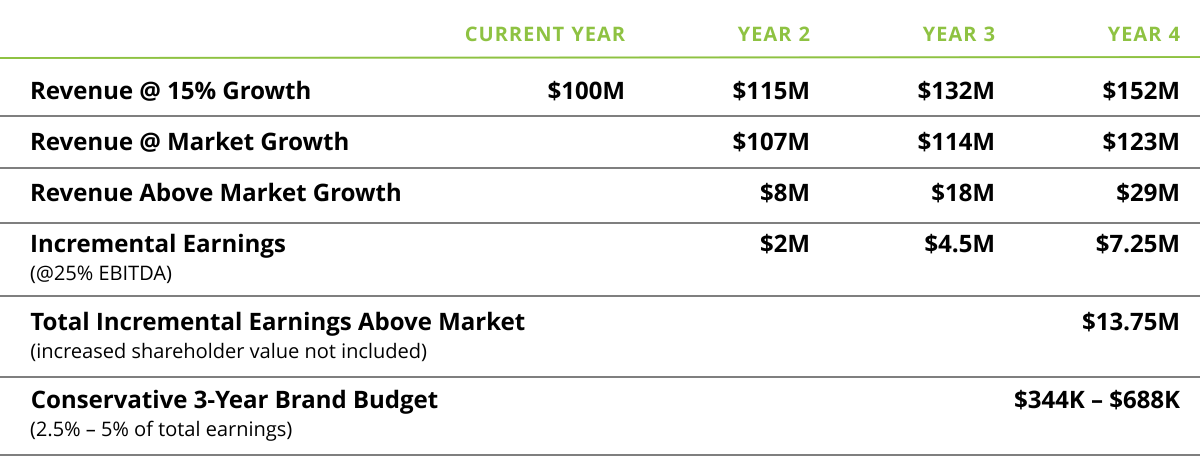
In this example, a $100 million software company is growing at the market growth rate, 7 percent. They are seeking 15 percent annual compounded growth. At 2.5 to 5 percent of total incremental earnings, their conservative investment in brand should be $344,000 to $688,000. That amount would cover brand creation and internal and external activation, including brand systems, website changes, and launch and awareness investments.
Note that we have not included shareholder value in our calculation, ask your CFO for help here. From this view, brands contribute to earnings and increase shareholder equity. Marketers unlock the true value of brand creation and activation in this more complete view of ROI.
Don’t jailbreak your brand under darkness of night
All of your hard work in creating a stand‑out brand will not generate ROI unless disciplined activation, internal and external, is part of the project. Activation planning is not a two to three‑hour session followed by a website change, new collateral, and a digital awareness campaign. We call this jailbreaking a brand.
Instead, include a robust activation across key customer touchpoints. When you include this in ROI calculations, you will find adequate budgets to rebrand successfully, and you will achieve your return on investment.
Key takeaway
Balance hypotheses with validation, participation with speed, and strategy with funded activation. That is how a rebrand creates measurable value.
FAQs
How much research do we really need before we start a rebrand?
Use what you have to form a hypothesis, then budget for fast back‑end validation with buyers. Spend research where it proves or improves the answer.
How do we keep executives engaged without slowing everything down?
Put leaders on the core team with clear roles, structured working sessions, and decision checkpoints. Fewer reviews, more creation.
How do we defend the budget for activation, not just identity?
Tie investment to incremental growth above market. Use a shared model to size creation and activation. Point stakeholders to detailed ranges in our rebrand budgeting article.
Published October 2022. Updated November 2025.