Brand
A brand identity should tell the truth
July 2026
A brand identity is not decoration. It is the clearest public evidence of what a company believes, how it works, and the value it creates.
TL;DR
- Start with truth: A useful identity reflects the business behind it, not a mood board in front of it.
- Design for behavior: The system has to work across digital channels, sales moments, AI summaries, and client conversations.
- Make it ownable: Distinctive elements matter when they help people recognize the brand faster and understand it better.
- Keep the promise intact: A refresh should make the company easier to read, not simply easier to notice.
What is a brand identity?
A brand identity is the connected system of language, visuals, signals, and behaviors that helps people recognize what a company stands for. Put simply, it should make the business easier to understand: what it believes, how it works, why it matters, and what customers can expect from it.
The look is only the visible part
Not just about how a company looks, but about what it believes, how it works, and the value it creates.
That is the part teams sometimes lose when they talk about identity. The conversation moves quickly to logos, palettes, typography, motion, and yes, the occasional passionate debate about gradient direction. Useful work, but incomplete work.
Academic research on visual brand identity frames it as more than a collection of assets. It connects the look and feel of a brand to strategy, consistency, and the individual elements that carry recognition over time.1 In other words, identity is a business system before it is a design system.
That matters because the world our clients operate in has changed dramatically. Markets move faster. Buying environments are noisier. AI is reshaping workflows and expectations. Google now documents AI features that organize and present site content directly in search experiences, which means brand clarity increasingly has to survive compression.2
Why StudioNorth changed
Over time, we realized our brand was no longer fully expressing the StudioNorth of today. We had changed, but parts of the system had not caught up.
As those conditions changed, StudioNorth changed too. We sharpened our point of view, strengthened our capabilities, and deepened our conviction in what helps brands grow: clarity, creativity, adaptability, and close collaboration.
That evolution led us to refine our positioning around a simple idea: helping brands become unmistakable. It also made us more disciplined about our own digital-first brand identity, because coherence now has to hold across people, platforms, and models.
Great. But what should change?
A brand refresh should answer three questions before anyone starts designing.
What is true about the company now
Every identity decision should begin with the business, not the asset library. What has changed in the offer, the operating model, the audience, the market, or the ambition?
For StudioNorth, the answer was clear. We are more strategically integrated, more AI-enabled, more motion-minded, and more committed to work that helps clients move what matters faster.
What needs to be easier to understand
Identity has to reduce friction. If a buyer, partner, recruit, or AI system needs five explanations to understand the brand, the system is working too hard.
This is where brand voice and visual identity have to pull together. The words set the terms. The visual system creates recognition. The behavior proves the promise.
What can we own
Our new look and feel is an expression of that idea. We built it from a digital-first perspective, designed to be clearer, more flexible, and more ownable wherever the brand shows up.
Distinctive asset research shows that logos, logotypes, characters, colors, and other identity elements vary in ownership potential, and that execution plays a critical role in whether those elements become recognizable.3 Put less academically: a brand cue only works if people can connect it back to you.
The system behind the signal
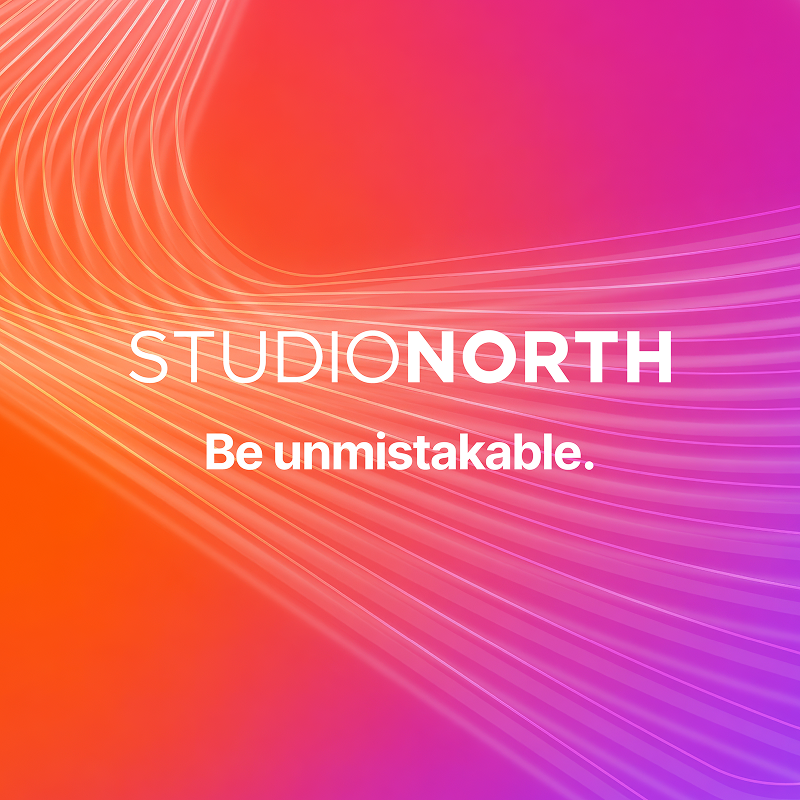
Gradients bring energy and dimensionality. The waveform adds a distinctive signal, something active, expressive, and alive. Increased use of motion helps the brand behave more like modern marketing.
Those choices are not just aesthetic preferences. They are distinctive brand assets built to travel across screens, presentations, social environments, and sales conversations. The point is recognition with meaning, not decoration with a logo attached.
Research on corporate visual identity also makes a useful distinction between rigid sameness and continuity over time.4 That distinction is important. A modern identity needs enough flexibility to adapt and enough discipline to still feel like the same company.
That balance is especially important in an AI-shaped market. If the brand looks different everywhere, reads differently everywhere, and describes itself differently everywhere, entity-based discoverability gets harder. So does human trust.
The truth has to hold
Together, those elements reflect a StudioNorth that brings strategic rigor, creative ambition, and close partnership to every engagement.
It is not about looking new for the sake of it. It is about better alignment between who we are, how we work, and how we show up for clients.
We may look different, but what has not changed is our belief that creativity is a business advantage. The best results still come from working side by side with clients to move what matters.
That is the trick, isn't it? A strong identity makes evolution visible without making the company feel unfamiliar. It gives the market a clearer read on the business, and it gives the business a clearer way to show up.
Key takeaway
A brand identity should tell the truth: what the company believes, how it works, and why it matters now.
FAQs
Why did StudioNorth refresh its brand identity?
StudioNorth refreshed its identity because the business had evolved. The new system better reflects its current point of view, digital-first capabilities, creative ambition, and collaborative way of working with clients.
What makes a brand identity truthful?
A truthful brand identity aligns what a company says, shows, and does. It expresses the beliefs, behaviors, and value already present in the business, then makes them easier for audiences to recognize and understand.
Why does visual identity matter more in an AI-shaped market?
AI and search systems often summarize brands before a person reaches the website. Consistent language, clear signals, and distinctive assets help the brand stay recognizable when information gets compressed, compared, and repeated.
What changed in the StudioNorth identity?
The refreshed identity uses a clearer digital-first system, more flexible visual expression, gradients, waveform elements, and motion. Each choice supports a more unmistakable StudioNorth across the places clients encounter the brand.
Sources:
1 Phillips, Barbara J., Edward F. McQuarrie, and W. Glenn Griffin. "The Face of the Brand: How Art Directors Understand Visual Brand Identity." Journal of Advertising 43, no. 4 (2014): 318-332. https://www.tandfonline.com/doi/abs/10.1080/00913367.2013.867824
2 Google Search Central. "AI Features and Your Website." Google for Developers. https://developers.google.com/search/docs/appearance/ai-features
3 Ward, Ella, Song Yang, Jenni Romaniuk, and Virginia Beal. "Building a Unique Brand Identity: Measuring the Relative Ownership Potential of Brand Identity Element Types." Journal of Brand Management 27 (2020): 393-407. https://link.springer.com/article/10.1057/s41262-020-00187-6
4 Gregersen, Magnus Kristian, and Trine Susanne Johansen. "Corporate Visual Identity: Exploring the Dogma of Consistency." Corporate Communications: An International Journal 23, no. 3 (2018): 342-356. https://www.sciencedirect.com/org/science/article/abs/pii/S1356328918000222
Ready to make your brand unmistakable?