When do standard B2B marketing KPIs become irrelevant?

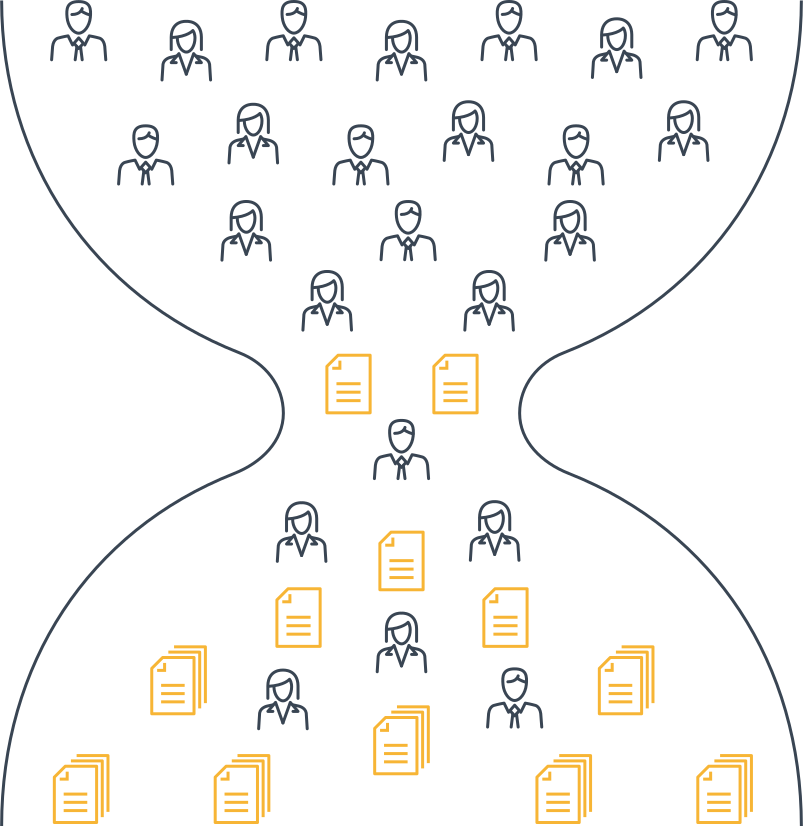
Not every metric deserves a seat at every stage. In B2B, the right KPIs change shape as the buyer journey narrows, like an hourglass.
TL;DR
- Use the classics early. Awareness and engagement KPIs still matter at the top.
- Switch at the midpoint. Once you have real leads, volume KPIs lose value. Depth and fit take over.
- Design for action. If a metric cannot change your next move, it is trivia.
What is the hourglass model for B2B KPIs?
It is a simple way to decide what to measure, and when. Use conventional awareness and engagement KPIs to earn attention at the top. At the midpoint, pivot to depth and fit. In the lower half, track who is engaged, how often, and how far, then act on it.
Awareness and engagement are at the top of the hourglass
B2B buyer journeys are rarely linear, but the old funnel still holds true in one respect. You have to make many potential customers aware of your offering, and engage quite a few of them, to identify the handful who may actually become customers.
Awareness and engagement are where it makes sense to use the familiar KPIs. But you should never decide on the KPIs for a B2B campaign without answering some basic questions:
- What is the campaign’s goal? Note the singular. A campaign can have multiple goals, but there needs to be an ultimate destination for your potential buyers.
- What are the tools you will need to measure that goal? Failing to have these tools from day one is like driving 200 miles before you realize you forgot your phone.
- Can what you are measuring help adjust your campaign? If not, they are not KPIs, because they are not key and they do not indicate anything useful.
Choose KPIs that will help you make critical changes during the campaign, or reassure you that those changes are not needed. Can you divert spend to where it is most effective? Can you introduce new creative to double down on what is performing? Measurement without any possible resulting action is just trivia.
And do not forget, it can take weeks or even months for awareness and engagement efforts to give you actionable results. Checking metrics after four days without a meaningful sample only adds noise and erodes decision quality.
What happens at the middle of the hourglass
B2B awareness and engagement campaigns are usually about identifying people and organizations who are strong candidates to become customers. For simplicity’s sake, whether you prefer MQLs, SQLs, OQLs, or just any old QL, let us call them leads.
Once you have leads it is time to stop measuring conventional marketing KPIs.
This is where the funnel becomes an hourglass. Instead of measuring how many people are aware of or engaged with your content, you now focus on how deeply each lead is engaged with your organization.
The bottom of the hourglass is a different world than the top. Your KPIs should be different, too.
KPIs at the bottom of the hourglass
Your goals at the bottom are almost 180 degrees from your goals at the top.
- In the early stages, you try to get as many people as you can to view or engage with any content you publish.
- In the later stages, those priorities flip. Now, you try to get a relatively small number of people to engage as deeply as possible with targeted content.
For instance, if this is the first time you have read one of our articles, you are one of the many people engaging with one piece of our content. You are in the top half of the hourglass.
But we hope you will join the smaller group who reads multiple articles, watches our videos, and reaches out for more information. Then you would be in the bottom half, and on our very short list of potential clients.
That is why conventional awareness and engagement KPIs are irrelevant in the bottom half. We are far less interested in how many people are reading this article, and far more interested in who you are, how many people in your organization you share it with, and how deeply you engage with the article.
How do we measure that? We will not share all our secrets. Here is a hypothetical example of how one asset can generate KPIs relevant to both halves, a webinar:
Top of hourglass metrics
- Landing page views
- Registrations
- Attendance
Bottom of hourglass metrics
- How many people from the same organization attended
- Who stayed through the full webinar
- Who asked questions
With the focus on opportunity and fit rather than volume, your digital metrics become more closely tailored to your offering as a lead gets closer to becoming a customer. You may even invent your own KPIs. That is where a personalized touch from a marketing team that understands your goals, your industry, and your audience matters.
How StudioNorth approaches KPI design and reporting
We start by clarifying objectives and instrumentation, then align KPIs to stages across strategy, content, and media. That keeps measurement useful and actionable from first touch through revenue. Learn more about our Performance Management practice, and how it connects with Marketing Strategy and Digital Activation.
Key takeaway
Do not force top‑of‑funnel KPIs on bottom‑of‑funnel work. Switch to depth‑and‑fit metrics at the midpoint, and let those guide your next move.
FAQs
When should we pivot from awareness metrics to depth metrics?
As soon as you have qualified leads. At that point, track frequency, recency, content depth, and buying‑committee spread instead of pure volume.
How often should we check KPIs?
Weekly at minimum for live campaigns. Give awareness efforts enough time to reach statistical usefulness before you pivot or pause.
What tools do we need in place on day one?
A shared KPI framework, CRM and marketing automation integration, lead and account tracking, and a reporting cadence owned by a single team.
Published December 2024. Updated November 2025.