How B2B buyer journey analysis can elevate your customer experience.

The journey does not end at purchase. Treat customer experience as the next chapter of the buyer journey. Keep mapping motivators and barriers, then design post‑sale moments that earn loyalty and growth.
TL;DR
-
Keep the map alive. The same signals that win new buyers will deepen existing relationships.
-
Look past satisfaction. NPS shows sentiment, not motivation. Pair quant with guided discovery.
-
Design post‑sale peaks. Create moments that reinforce value and trigger expansion.
What is buyer journey analysis for customer experience?
Buyer journey analysis for CX extends journey work beyond the initial sale. You study how customers behave after purchase, why they renew, expand, or leave, and which moments change outcomes. You pair quantitative measures with interviews, then align content, service, and product touches to remove friction and create value your customers can feel.
The B2B buyer journey does not end because a purchase was made. In fact, it never truly ends. Most modern marketers know the journey is a better model than a funnel. Yet many treat it as over once a prospect becomes a customer. That idea is wrong. Customers keep the same needs, fears, and priorities they had before the deal. If you want to keep and grow the relationship, view customer experience as an evolution of the journey, and keep evolving your understanding of why people buy.
Why a journey approach enhances CX
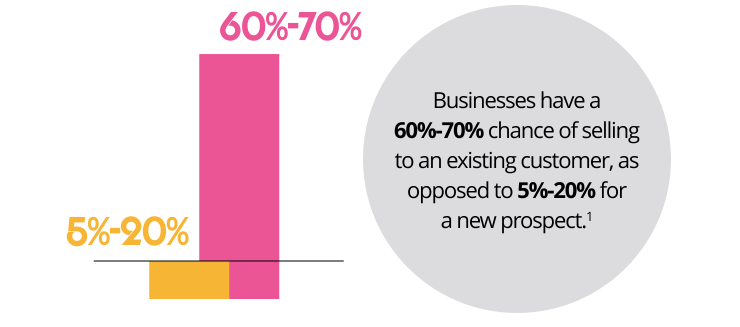
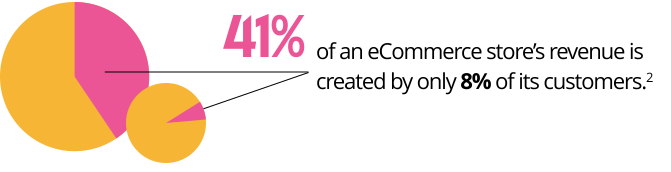
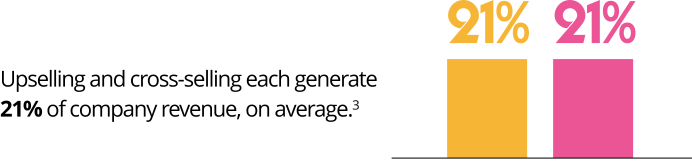
It is easier to grow sales with existing customers than with new ones. That line has been true for decades. Recent statistics point the same way. Existing customers buy more often. A small cohort often drives a large share of revenue. Upsell and cross‑sell deliver meaningful contribution. None of this is news. Companies have tracked lifetime value for years. Many even have customer experience teams. Still, organizations lose sight of a simple truth. Customers are buyers. Their journey continues long after the first purchase.
Understanding the journey your customer goes through is crucial to a superior experience. Everything you use for prospects, such as dynamic personas, journey mapping, and messaging platforms, works even better when you extend it to current customers. For cross‑references and practical models, start with: Build B2B campaigns on true buyer journeys and Level‑up customer experience: Lean on your marketing team.
Satisfaction scores do not tell the whole story
NPS and other satisfaction metrics are essential. They quantify the experience and reveal root causes to fix. They do not explain why customers buy, why they do not buy, or why they buy less than expected. Quantitative measures cannot define the depth of commitment or the true quality of the relationship. Journey analysis fills that gap. It seeks to understand what decision‑makers face each day, and what motivates them to move forward into a deeper relationship, or not. That understanding is critical if you want to maximize account penetration and retention.
Guided discovery that finds deeper insights
At StudioNorth, we use a guided discovery approach to add a qualitative dimension to journey analysis. One‑to‑one or one‑to‑few interviews with decision‑makers surface the lived experience. Instead of fixed scores or ranking questions, we ask open prompts about daily challenges and how people feel about working with your organization. We do not use a rigid script. Conversations range from general to specific, which reveals the moments that change behavior.
Example prompts:
- What helps you accomplish your objectives day to day.
- Which moments with us make you want to deepen the relationship.
- How do you budget to expand a solution across locations.
- What drives a decision to buy parts of a suite, but not others.
The goal is not to compile scores. It is to discover insights about feelings, goals, and obstacles. We learn the moments and motivations that trigger buying decisions, and the concerns that block them. Guided discovery extends journey analysis into CX, because the journey never ends.
Design post‑sale moments that move the needle
Map the post‑sale journey by role. Identify adoption hurdles and aha moments. Then engineer peaks that prove value and reduce risk.
Examples:
- Onboarding clarity. A short video that shows first value in minutes, plus a checklist by role.
- Confidence signals. A peer story that mirrors the customer’s industry and use case.
- Expansion triggers. A light assessment that exposes gaps and recommends next modules.
Route these assets through channels your customers already use. Pair email with in‑product prompts. Equip account teams with tailored follow‑ups. Tie every moment to a next best action.
Measure what matters after the sale
In the post‑sale journey, depth beats volume. Track completion, multi‑asset engagement, product activation, ticket deflection, and expansion velocity. Connect these to opportunity creation and renewal rates. Use shared readouts so marketing, product, and success teams see the same story. For a system that turns this into action, connect with Performance Management.
Key takeaway
Your customers are still on a journey. Extend journey analysis beyond the sale, pair quant with qualitative discovery, and design post‑sale peaks that earn loyalty and growth.
FAQs
How often should we refresh post‑sale journey maps?
Update them twice a year, or after major launches and pricing changes. Pull new interview insights into the map, then realign onboarding, success plays, and content.
What if we do not have bandwidth for interviews?
Start small. Ten short interviews across three roles can change your roadmap. If schedules are tight, use voice notes with permission, then summarize themes in a workshop.
Which teams should own post‑sale journey analysis?
Make it a joint effort. Marketing facilitates the research and messaging. Product and success bring usage data and customer context. Sales adds expansion signals.
Sources
1 SEMRush, “65 Customer Retention Statistics You Need to Know in 2024,” January 2024
2 Smile.IO, “What is a Repeat Customer, and Why are they Profitable?” May 2024
3 HubSpot, 2024 State of Sales Report
Published November 2024. Updated November 2025.